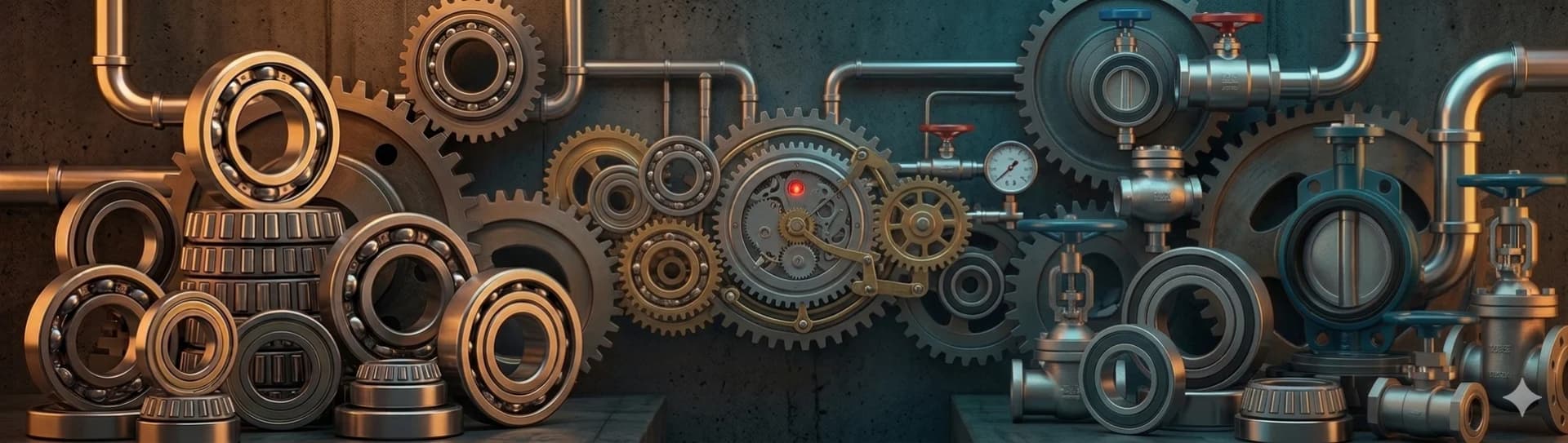
Ball Bearings
One of the most important components used in industrial machinery and household equipment is a ball bearing. It is designed to connect two machine components that move relative to each other, enabling smooth and low-friction motion. In most applications, one component rotates while the other remains fixed, such as a rotating shaft inside a stationary housing.

Thrust Ball Bearings

Self Aligning Ball Bearings

Double Row Angular Contact Ball Bearing

Single Row Deep Groove Ball Bearings

Double Row Deep Groove Ball Bearings
Ball bearings reduce friction and support efficient movement, improving machine performance, durability, and operational efficiency.
A ball bearing is not a single part but an assembly of multiple components. The primary parts of a ball bearing include:
- Inner Ring: A grooved raceway mounted on the rotating shaft.
- Outer Ring: A grooved outer raceway fixed inside the housing.
- Steel Balls: Hardened balls that roll between the inner and outer raceways.
- Retainer / Cage: Holds the balls evenly spaced and prevents contact between them.
The balls rotate smoothly between the two rings, replacing sliding friction with rolling friction. This results in low wear, smooth operation, high efficiency, and long service life.
Types of Ball Bearings
- Radial Ball Bearing:- Radial ball bearings are the most widely used type of ball bearings, designed primarily to handle loads acting perpendicular to the shaft. These bearings offer smooth high-speed operation and are suitable for a variety of industrial and automotive applications.
- Angular Contact Ball Bearing:- Angular contact ball bearings are specially designed to support both radial and axial loads simultaneously. Their unique raceway design allows them to carry higher thrust loads in one direction and provide reliable performance in high-speed applications.
- Single Row Ball Bearing:- Single row ball bearings feature a compact design with a single row of rolling balls, making them ideal for applications requiring low friction, smooth rotation, and easy installation with minimal alignment issues.
- Double Row Ball Bearing:- Double row ball bearings are designed with two rows of balls to provide higher load carrying capacity and improved stability. Their self-aligning capability helps compensate for shaft misalignment during operation.
- Ball Thrust Bearing:- Ball thrust bearings are specifically designed to handle axial or thrust loads. They consist of grooved washers and ball assemblies, making them suitable for applications involving high thrust forces and low radial loads.
Applications of Ball Bearings
Aerospace & Aircraft:-
Ball bearings are widely used in aircraft systems, jet engines, helicopters, and aerospace control equipment where precision, reliability, and high-speed performance are critical.
Automotive Industry:-
In the automotive sector, ball bearings are essential components used in engines, gearboxes, wheels, electric motors, and steering systems to ensure smooth vehicle operation.Railways:-
Railway applications require heavy-duty ball bearings capable of handling high loads, continuous operation, and varying speeds while minimizing wear and maintenance.
Textile Industry:-
Ball bearings are extensively used in textile machinery, spinning mills, and weaving equipment to provide smooth rotation, reduced friction, and uninterrupted production.Medical & Dental Equipment:-
Miniature and precision ball bearings are commonly used in medical instruments, dental tools, diagnostic devices, and surgical equipment for accurate and reliable operation.Engineering Equipment:-
Industrial machinery such as pumps, motors, compressors, conveyors, and heavy-duty equipment rely on ball bearings for efficient motion, reduced downtime, and improved productivity.Sporting & Consumer Goods:-
1. What is the basic principle of ball bearings?
Ball bearings work by replacing sliding friction with rolling friction.
2. What is a ball bearing device?
A ball bearing device is a mechanical component that supports rotating shafts while reducing friction and allowing smooth motion.
3. What material is used for ball bearings?
Ball bearings are commonly manufactured using chrome steel, stainless steel, or alloy steel.
4. Who uses ball bearings?
Industries such as automotive, aerospace, manufacturing, railways, electronics, and medical equipment use ball bearings.
5. Why are ball bearings used in motors?
Ball bearings help motors run smoothly by reducing friction and improving efficiency.
6. What is ball bearing size?
Ball bearing size refers to the bore diameter, outer diameter, and width of the bearing.
7. What is a ball bearing’s radius?
It refers to the curvature of the raceways that allows smooth rolling contact.
8. What are the advantages of ball bearings?
- Reduced friction
- Smooth operation
- High-speed performance
- Long service life
Ball Bearing Supplier in India — Aarya Sales
Aarya Sales supplies a comprehensive range of industrial ball bearings in India including Deep Groove Ball Bearings, Angular Contact Ball Bearings, Self-Aligning Ball Bearings, and Thrust Ball Bearings from ISO-certified global manufacturers.
Our ball bearings are available in bore sizes from 3 mm to 340 mm+ in ABEC 1 through ABEC 7 precision grades. Variants include open, ZZ (metal shielded), and 2RS (rubber sealed) for diverse contamination and lubrication requirements. Applications: electric motors, pumps, gearboxes, fans, compressors, textile machinery, and precision instruments. C2/CN/C3/C4 clearances available. Fast pan-India delivery from Delhi.
Frequently Asked Questions
We supply Deep Groove Ball Bearings (DGBB), Angular Contact Ball Bearings, Self-Aligning Ball Bearings (1200/2200 series), Thrust Ball Bearings (511/522 series), and Miniature Ball Bearings — available in open, ZZ, and 2RS variants from ISO-certified manufacturers.
We stock ball bearings from 3 mm bore (DGBB 603 series) up to 340 mm bore and above. Standard ISO 60000, 62000, and 63000 dimension series are available ex-stock in Delhi. Special sizes and flanged variants available on request.
Open bearings have no sealing — suitable for external re-lubrication. ZZ (Z/2Z) metal shields protect from dust and splash while allowing some re-lubrication. 2RS (RS/2RS) rubber contact seals provide the best exclusion of dirt and moisture, pre-greased and sealed for life — ideal for maintenance-free applications.
C2 for precision interference-fit applications; CN (normal, default) for most standard conditions; C3 for electric motors, vibrating screens, and high-temperature environments; C4 for extreme temperature or heavy vibration. Always specify clearance when ordering if non-standard.
Electric motor manufacturers, pump and compressor OEMs, textile machinery (ring frames, looms), gearbox manufacturers, conveyor systems, automotive component suppliers, agricultural equipment, and general engineering industries across India.
Yes. C3 clearance DGBB bearings specifically for electric motors are stocked in standard IEC motor frame sizes (6200, 6202, 6204, 6205, 6206, 6208, 6210, 6212 series and equivalents) in both open and 2RS variants.